Reading Piano Notes: Complete Beginner's Guide

In musical compositions, along with musical notes, you'll find many numbers and symbols. This system of symbols is called musical notation.
At first glance, these markings may seem intimidating, but don't get discouraged. In this article, we'll cover nine fundamental principles you need to master musical notation.
We'll focus on musical notation for piano, but don't worry – it's identical for trombone, balalaika, or violin.
Notes
Translated from Latin, the term "note" means "sign" or "mark". Notes, like the letters of the alphabet, are graphic symbols. On the staff, each note represents a specific sound and its duration. From the appearance of a note outside the staff, we can only determine its duration. The length of time a note sounds is called its duration, which we'll discuss now.
Note durations
Let's imagine the following scenario before we begin: someone offers you an apple and tells you to eat it as quickly as possible. Naturally, this will take some time. Now imagine you were given only half an apple. It's logical that you could finish half in half the time. And now imagine you were offered just a quarter of an apple – you could eat it four times faster, and so on.
Now let's turn to the main durations and examine their names carefully.
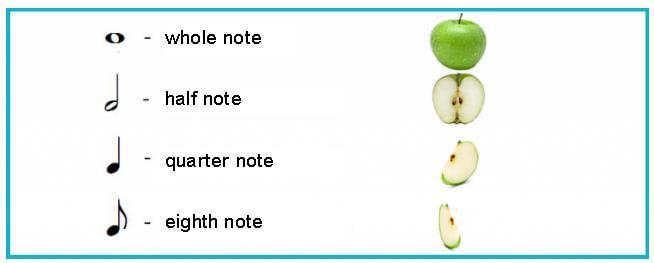
Here's how the division of notes looks.
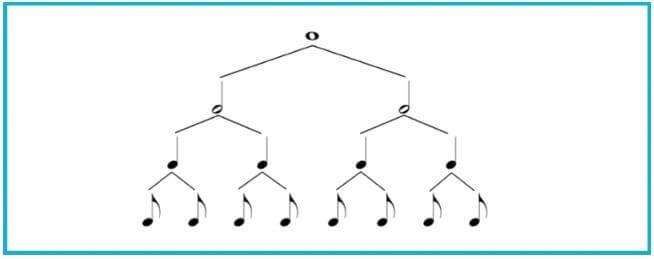
- A whole note represents the longest sound duration.
- A half note lasts half as long as a whole note.
- A quarter note sounds half as long as a half note and a quarter as long as a whole note.
- An eighth note lasts half as long as a quarter note, a quarter as long as a half note, and so on. To fill the duration of a whole note, you need to use eight eighth notes.
- There are shorter durations such as sixteenth, thirty-second, and sixty-fourth notes.
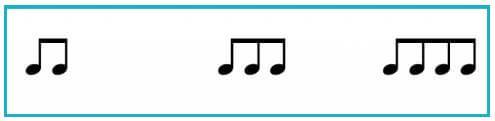
Eighth notes and smaller durations can be grouped together, and their appearance changes accordingly.
Below is an example of combining eighth notes into one group.
What Does Time Signature Mean and What is a Beat
Every piece of music has its own time signature. But what does this concept mean? To understand this, we need to familiarize ourselves with the terms pulse, beat, and meter.
You've probably been to concerts where the audience began applauding during the artist's performance. The clapping may sound chaotic at first, but after a few seconds, everyone starts clapping in unison. People feel the pulse and therefore clap rhythmically and in sync. This regularity that characterizes musical movement is what we call pulse.
The pulse has its own unit of measurement, which is called a beat. Beats are rhythmic, but they have different strengths. Among them are strong and weak beats. The first beat is always strong and is shown in red on the chart. Weak beats are shown in blue.

The pattern of strong and weak beats forms the meter of a piece of music. In this example, we see three beats, but this is only one of many possible patterns.
The distance between two adjacent strong beats is called a measure. In notation, measures are separated by bar lines.

Now that we're familiar with the definitions of meter, beat, and measure, we can examine the concept of time signature.
The time signature of a piece of music is a structure that resembles a mathematical fraction, but without a dividing line. Here are some sample time signatures:
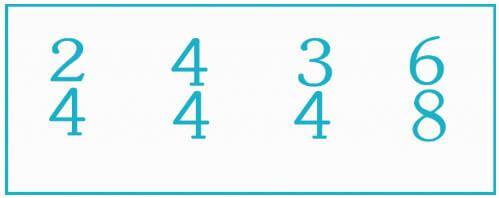
The top number in the time signature indicates how many beats are in one measure.
The bottom number determines the duration of each beat.
The top number tells you how many beats to count in each measure (for example, 2, 4, 3, 6, and so on).
The bottom number determines which note value gets the beat (for example, quarter notes, eighth notes, and so on).
Even though beats are even, measures can be filled with notes of different durations. Thus, eighth notes, sixteenth notes, quarter notes, and other durations can be combined in one measure.

Accidentals – Sharp, Flat, Natural
Music notation contains various symbols, some of which may look like hieroglyphs. Let's discuss these symbols in more detail.
In music, alteration means a change to the basic steps of a key. These steps are represented by notes (C, D, E, F, G, A, B). The pitch of a step can be raised or lowered. Special signs have been developed to indicate these changes:
Sharp – raises the pitch of a note by a semitone.
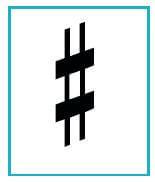
Flat – lowers the pitch of a note by a semitone.

A semitone defines the distance between two adjacent keys on an instrument.
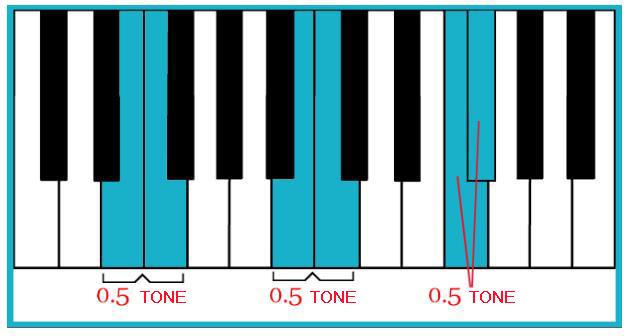
The illustration below shows how sharps are arranged on a piano keyboard.
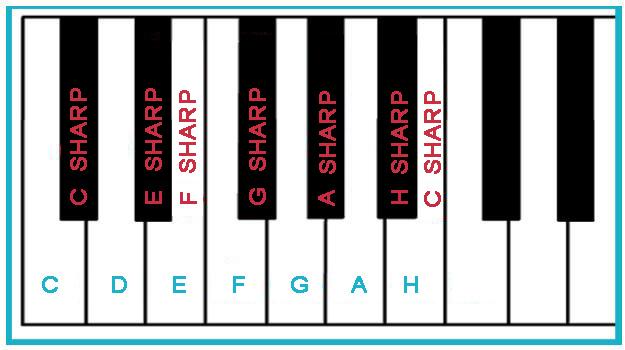
Notice that the E sharp key is in the same position as the F key. This is because there's only a semitone between them. As I mentioned, a sharp raises a note by a semitone, which means E sharp becomes F. The same is true for B sharp, F flat, and C flat.
The illustration below shows the location of flats:
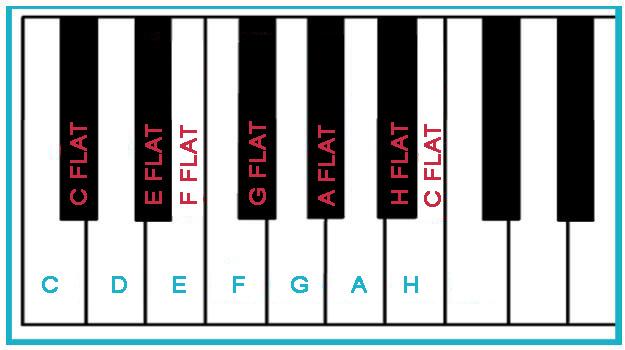
Notice that sharps and flats occupy the same keys. This means that D sharp is actually equivalent to E flat. In a sense, you're right – these keys sound the same, but on paper, their notation must follow the rules determined by the key signature.
How to Write Sharps and Flats Correctly
Contrary to how we pronounce note names and accidentals, when they're written down, the order is reversed. First the accidental sign is written, then the note. Take a look:

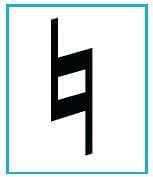
Among the accidentals, the natural sign is particularly important.
Natural is a symbol that cancels the effect of both flats and sharps. If you see this symbol before a note, it means you need to play a regular white key – that is, a note without alteration. Here's what the natural symbol looks like:
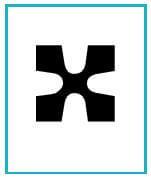
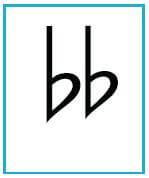
The first symbol looks like a cross and raises a note by two semitones (that is, by a whole tone). The second symbol represents two flats in a row and lowers a note by two semitones. If in musical notation there's an F note with a double sharp symbol, we'll play the G note on the instrument.
This may seem odd – why not just use the G note? However, music has much in common with mathematics, and there are rules that must be followed. That's why double sharp and double flat symbols were introduced.
Treble and Bass Clef
Using a musical staff, we can visually determine which sounds are higher and which are lower, but only relative to each other.

What if there's only one note on the staff? How do we determine its pitch? To clarify this, we need to introduce the concept of a clef.
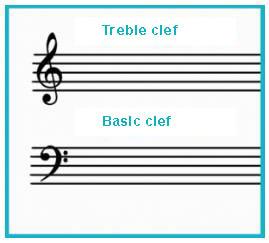
The clef is a symbol that defines the position of a specific note on the staff. Let's examine this more closely.
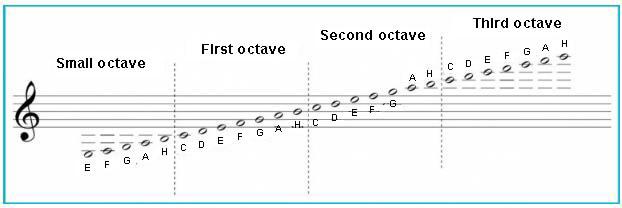
In the current notation system, notes on the staff are arranged as follows:

Notice that in the treble clef, low notes are written on ledger lines, just like high notes in the bass clef. Imagine what musical notation would look like if only one clef were used. There are 88 keys on the piano, and each must somehow be represented on the staff. However, only 5 lines are available. This would require using many ledger lines, which would be inconvenient for visual perception and reading music.
Therefore, in the 11th century, music theorist Guido d'Arezzo proposed special symbols – clefs. Clefs were created to serve as a reference point on the staff and indicate the note from which all others should be counted.
You probably know that notes have syllabic names (C, D, E…), but can also be denoted by letters of the Latin alphabet. For example, the note G is denoted by the letter G. It was this letter that served as the basis for creating the treble clef.
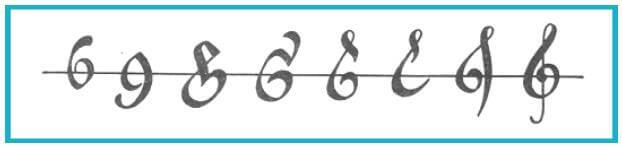
As you can see, the main curved line wraps around the second staff line. Thus, the clef tells us that the note G is on the second line. Knowing this, we can easily determine the location of the remaining notes.
This clef is called "treble" because it's used for the range that the violin plays. This is how notes are arranged in the treble clef in the first octave.

The curl of the bass clef intersects the fourth line of the staff, and two dots frame it on both sides. Like the treble clef, the bass clef serves as a reference point – in this case, for the note F. Knowing this, we can easily determine the location of the remaining notes. In the small octave, they're positioned as follows:

Pauses in Music
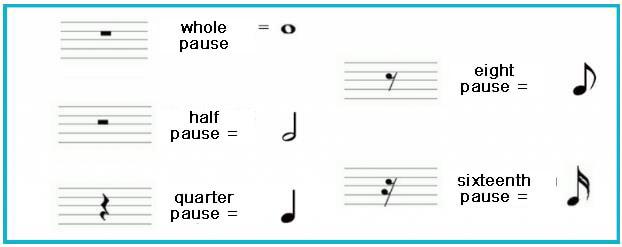
In music, the moment of silence when there's no sound is called a rest. Like notes, rests can have different durations. The names of rests correspond to note durations, but their graphic representation is different. Below are the main rests and their corresponding note durations.
We agreed that a rest is a moment of silence. However, if you play piano and rest with only one hand, you won't hear true silence. If you're interested in the concept of musical silence, I recommend listening to a piece by John Cage called "4'33"". In this composition, the musicians performing it don't produce a single sound. Instead, the audience becomes aware of surrounding sounds and finds harmony with the environment. The performance of this work in its original interpretation can be found online.
Musical Staff – What is Located on It
Sound has various physical characteristics, and one of them is its frequency. In music, the frequency of a sound is usually referred to as pitch. But how can we represent this pitch on paper?
This question was answered by Italian monk, teacher, and theorist Guido d'Arezzo at the beginning of the 11th century. He proposed depicting sounds of different pitches on parallel lines, one above the other. This system was called the staff.

Scale, Octave, Range
Let me remind you that there are only seven basic notes. They're arranged sequentially one after another: C, D, E, F, G, A, B. This sequence is called a scale. In school, children are taught the rule: if sounds are arranged in this sequence, it's a scale.
This sequence can be repeated indefinitely. For example, after the note B comes C again, and so on. The distance between two C notes, one lower and one higher, is called an octave (from the Latin word for eight).
And indeed, if we count: C – 1, D – 2, E – 3 … B – 7, then the next note after B will again be C and will be numbered 8. It will be the first note in the next octave.
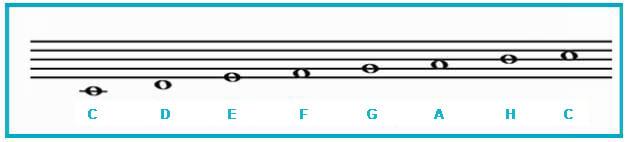
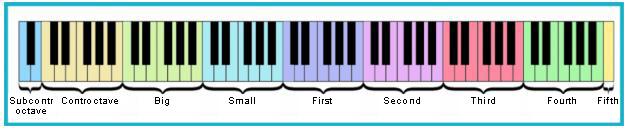
Historically, nine octaves have been most commonly used in music. Every musical instrument, as well as the human voice, has its own pitch limitations. That is, each can produce a lowest and highest note within its range. The distance between the lowest note in the lower register and the highest note in the upper register is called the range. Each instrument and voice has its own unique range. Range is usually measured in octaves. For example, on a piano you can find seven full octaves and two partial octaves. Therefore, if you play the keys sequentially from low to high, the scale (C, D, E, F, G, A, B) will repeat completely seven times.
Dynamics
Musical language, like human speech, has pronounced emotion. It has many nuances that are achieved in music through dynamics and performance variations. The word "dynamics" comes from the Greek word "dynamis", which means "strength". Therefore, dynamics in music relates to the volume of sound. Special Italian terms are used to indicate different levels of sound intensity. The table below shows the main dynamic markings along with their interpretation.
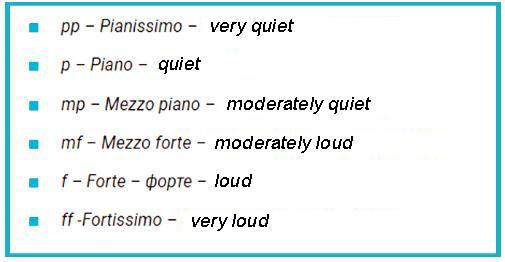
When writing music, the composer determines the dynamic markings for each section. Thus, in one composition, the dynamics can change several times.
Musical Articulation
Music reference books state that articulation is a method of producing sound on various musical instruments. For example, on piano, sound production depends on how you strike the keys, and on violin, on how the bow contacts the strings. Each group of instruments (keyboard, percussion, string, etc.) has its own sound production methods, which are called articulations. The term comes from a French word meaning "to touch" or "to articulate".
There are certain articulations that can be performed on almost any instrument. However, there are also articulations specific to certain instruments. For example, the "pizzicato" articulation is only possible on bowed string instruments. Below are examples of several musical articulations.
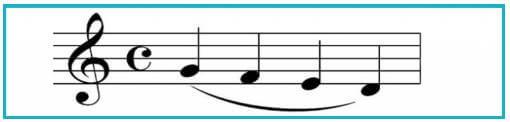
The curved line drawn over notes is called the slur. The sounds of these notes flow smoothly into each other. This articulation is called "legato".
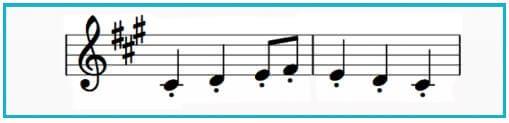
Dots placed above notes indicate a short, detached sound. This technique is called "staccato".
There are many other musical articulations you can explore.
Additional Musical Symbols
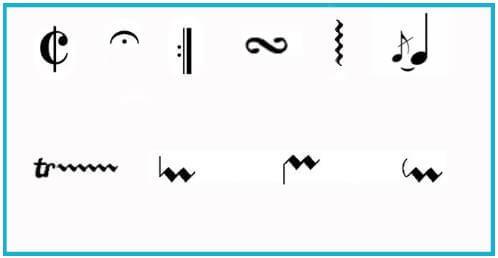
In this article, we've examined the main aspects of musical notation and the primary symbols of music notation. However, there are many other symbols we haven't covered that are equally important. Some relate to ornaments – decorative embellishments in music – and there are also symbols that help simplify writing and reading music.
The illustration below shows several of these additional symbols you'll encounter as you continue your musical journey. While they deserve a separate discusssion, familiarizing yourself with what they look like will help you recognize them when you encounter them in sheet music. As you advance in your piano studies, you'll naturally learn how and when to use these markings in your playing.