What Is a I-IV-V Blues Chord Progression?


The I-IV-V blues chord progression is a three-chord pattern built on the 1st, 4th, and 5th degrees of a major scale, typically using dominant seventh chords and arranged in a 12-bar structure. In the key of C, these chords are C7, F7, and G7.
This progression is the foundation of blues music and has shaped rock, jazz, funk, and country for over a century. Learn it once, and you can jam in any key, recognize chord changes by ear, and understand how thousands of songs are built.
In this guide, you'll learn:
- How the I-IV-V progression works in the 12-bar blues format
- Why blues uses dominant seventh chords instead of major chords
- The exact bar-by-bar structure you can use immediately
- 10 classic songs that use this progression
How the 12-Bar Blues Structure Works
The 12-bar blues arranges three chords across twelve measures in a repeating cycle. Each chord has a specific role: the I chord establishes the key, the IV chord creates movement, and the V chord builds tension that resolves back to the I.
Here's the standard layout:
- Bars 1–4: I chord (establishes home base)
- Bars 5–6: IV chord (moves away from home)
- Bars 7–8: I chord (returns home)
- Bar 9: V chord (creates tension)
- Bar 10: IV chord (begins resolution)
- Bars 11–12: I chord (resolves, or uses a "turnaround" to restart)
This structure is so universal that musicians can join a blues jam without rehearsal. Everyone knows where they are in the form and what's coming next. Once you've learned the pattern in one key, transposing to another key is straightforward—the relationships between chords stay identical.
Why Blues Uses Dominant Seventh Chords
Here's what separates blues from standard major-key harmony: every chord is a dominant seventh, including the I chord.
In traditional music theory, only the V chord is a dominant seventh (it naturally contains that flatted seventh note). The I and IV chords are typically major sevenths or simple triads. Blues breaks this rule deliberately.
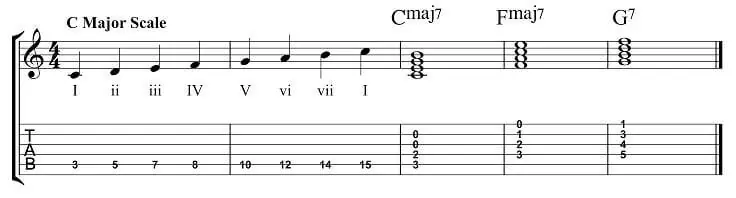
- Standard major progression: Cmaj7 – Fmaj7 – G7
- Blues progression: C7 – F7 – G7
That added seventh on every chord creates constant tension and "bite." There's no pure resolution—even the home chord has edge. This is the harmonic DNA of blues: raw, unresolved, expressive.
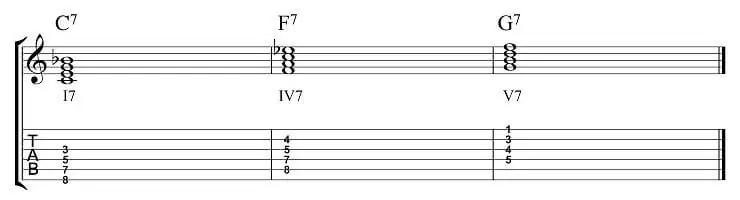
The dominant seventh sound also blends naturally with the blues scale, which includes the flatted third and flatted seventh. When you solo over a I7 chord using the blues scale, those "wrong" notes suddenly sound right.
The 12-Bar Form in Detail
Let's map out exactly where each chord falls. In the key of C:
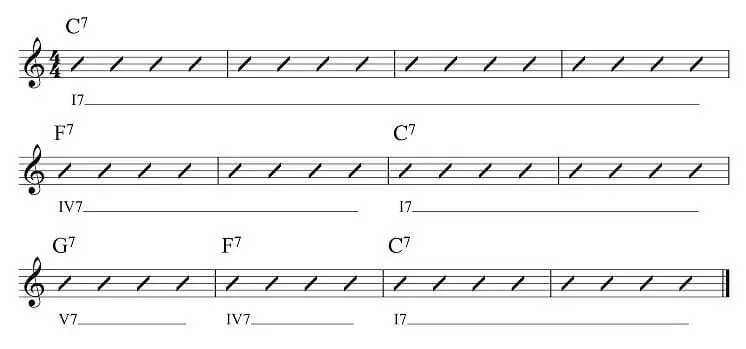
Bar 12 often features a turnaround—a quick V chord (or V-IV movement) that propels you back to bar 1. This keeps the form cycling without stopping.
Variations exist. Some players add a IV chord in bar 2 (the "quick change"). Others substitute chords for jazz-influenced versions. But this basic skeleton remains the standard.
Rhythm: The Shuffle Feel
The chord progression is only half the equation. Blues typically uses a shuffle rhythm—a swing feel where eighth notes are played unevenly, with the first note longer than the second.
Instead of straight eighth notes (1-and-2-and-3-and-4-and), shuffle eighths feel like triplets with the middle note removed. This creates that signature "bounce" or "lilt" that defines blues groove.
When practicing the I-IV-V progression, try playing each chord with a shuffle strum pattern. The difference between straight and shuffle rhythm is the difference between sounding like an exercise and sounding like blues.
Transposing to Other Keys
One major advantage of understanding the I-IV-V structure: it works identically in every key. You're not memorizing chord names—you're memorizing relationships.

Guitarists often favor E and A because open-position seventh chords fall naturally on the fretboard. Pianists might prefer C or F. Horn players often call tunes in Bb or F. The progression adapts to any instrument.
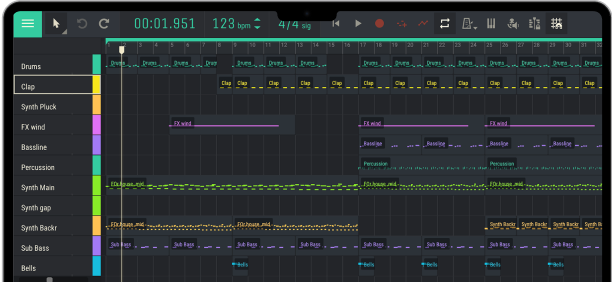
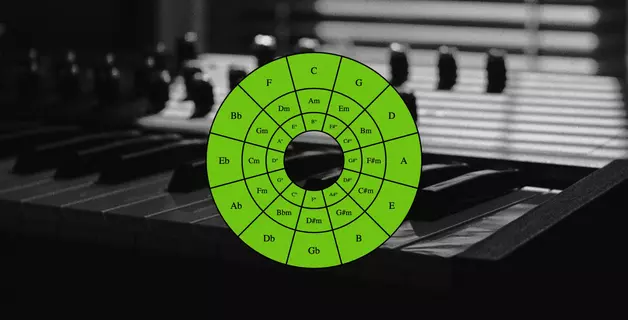
If you're working in a DAW and want to experiment with blues progressions, a chord generator can show you these shapes in any key instantly.
10 Classic Songs Using the I-IV-V Blues Progression
Hearing the progression in context is the fastest way to internalize it. These ten tracks demonstrate how different artists interpret the same 12-bar form:
1. "Sweet Home Chicago" – Robert Johnson / Buddy Guy The definitive Chicago blues standard. Both versions follow the 12-bar form closely—compare Johnson's acoustic Delta approach to Guy's electric interpretation.
2. "Crossroads" – Robert Johnson / Cream Johnson's original is stark Delta blues. Cream's 1968 version explodes the form into rock, with Clapton's extended solos over the same I-IV-V changes.
3. "Texas Flood" – Stevie Ray Vaughan Slow blues in G with SRV's signature tone. The extended intro and turnarounds show how players stretch the basic form.
4. "Red House" – Jimi Hendrix Hendrix plays a 12-bar blues in B, adding his chord embellishments and expressive bends while the I-IV-V foundation stays rock solid underneath.
5. "Stormy Monday" – T-Bone Walker A jazz-influenced blues with substitution chords, but the I-IV-V skeleton is still audible. Great example of how the form accommodates sophistication.
6. "Dust My Broom" – Elmore James The slide guitar riff that launched a thousand imitations. Pure 12-bar form with that iconic boogie pattern.
7. "I Can't Quit You Baby" – Otis Rush / Led Zeppelin Slow blues that Zeppelin covered on their debut album. Both versions show how dynamics and phrasing bring life to the same progression.
8. "Boom Boom" – John Lee Hooker Hooker often played looser with bar counts, but "Boom Boom" sticks closer to the form. The driving rhythm makes chord changes feel inevitable.
9. "Pride and Joy" – Stevie Ray Vaughan Uptempo Texas shuffle in E. The rhythm section locks into that shuffle groove while the progression cycles relentlessly.
10. "Black Magic Woman" – Fleetwood Mac Peter Green's original (before Santana's famous cover) is a minor blues variation, showing how the I-IV-V concept adapts to minor keys.
Conclusion
The I-IV-V blues progression is one of the most important patterns in Western music. Three chords, twelve bars, and a shuffle rhythm—that's the entire foundation. Master it in one key, and you can transpose it anywhere. Learn to hear it, and you'll recognize the structure in hundreds of songs you already know.
Start by playing through the progression slowly in E or A (guitarist-friendly keys) or C (piano-friendly). Get the dominant seventh voicings under your fingers. Then put on any track from the song list above and play along. The form will become second nature faster than you expect.
FAQ
I-IV-V refers to chords built on the 1st, 4th, and 5th degrees of a major scale. In C major, that's C, F, and G. Roman numerals indicate scale degrees, so the pattern works in any key.
The 12-bar form balances repetition with movement. Four bars establish the key, the middle section creates tension, and the final bars resolve it. This structure is long enough to tell a musical story but short enough to cycle continuously.
Absolutely. Rock, country, folk, and pop all use I-IV-V progressions constantly. "La Bamba," "Twist and Shout," and thousands of three-chord songs follow the same harmonic logic, just with different rhythms and chord voicings.
A turnaround is a chord phrase at the end of a 12-bar cycle that creates momentum back to bar 1. Common turnarounds use the V chord, a V-IV movement, or chromatic bass lines descending to the I chord.
For authentic blues sound, yes. Dominant seventh chords provide the tension and "bluesy" quality that defines the genre. Simple major triads will work harmonically but won't capture the blues feel.