AI in Music Production: Which Tools Actually Work for Professionals?


AI in music production has moved from experimental novelty to practical workflow integration — but often in other ways than all the hype around this topic suggests. As of early 2026, artificial intelligence in music excels at technical tasks like stem separation, spectral mixing assistance, and mastering optimization. Where it consistently fails (for now) is actual one-click song generation that would be completely artifact-free, akin to a professional studio production. This guide distinguishes production-ready tools based on professional studio adoption patterns. Read on if you, like us, want to separate the hype from the facts.
AI music marketing claims differ significantly from actual professional studio practices. While AI music generators like Suno receive significant media attention, professional AI adoption focuses on technical utilities to a greater extent: separating vocals from instrumentals, suggesting EQ curves, and automating LUFS normalization for streaming platforms.
Music AI: Competition Or Creative Partner?
The most common misconception about AI in music production presents artificial intelligence as composer replacement. The reality observed in professional electronic music workflows reveals a different application: breaking creative paralysis.
Many aspiring producers working in genre-specific contexts — techno, house, drum & bass etc — often face a modern paradox: access to unlimited sample libraries creates choice paralysis rather than inspiration. Scrolling through 10,000+ kick drum samples wastes creative energy needed for arrangement decisions.
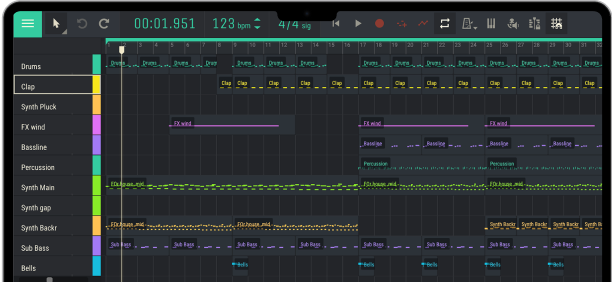
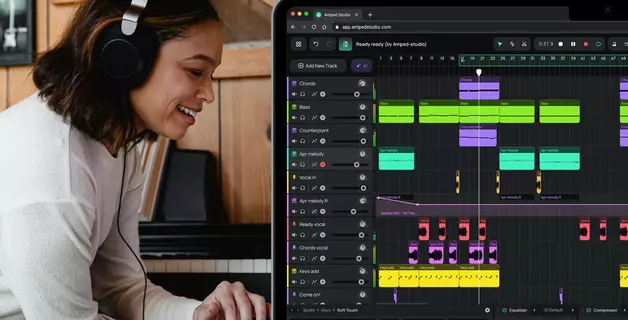
Rather than expecting to magically generate a hit song with one click, professionals focus on identifying concrete problems and finding best tools to fix them. Blank page syndrome? A tool like Amped Studio's AI Assistant can generate a multi-track starting point in specific genres, providing concrete material to modify rather than paralizingly limitless options.
The workflow distinction matters a lot in this case: AI-generated music serves as raw material for transformation, a starting point rather than a finished product. A more discerning approach that extracts value selectively — using an AI-generated bassline with an interesting synth timbre while discarding everything else, or keeping only an unexpected chord progression as harmonic foundation for original composition you build around it.
This reframes AI vs human creativity from competition to collaboration. AI suggests, while human curates and transforms. Creative decisions remain entirely human: which elements have potential, how to develop them, what emotional narrative the final piece should convey.
Let's focus on other common music production scenarios where a new generation of AI-powered music tools excels.
Stem Separation: From Free Tools To Paid Services
AI stem separation represents one of artificial intelligence's most immediately practical music production applications. The technology isolates individual elements — vocals, drums, bass, other instruments — from mixed stereo files, enabling remixing, sampling, and audio repair workflows previously requiring expensive studio separation techniques. The significant development is that the best tool costs nothing.
A brief reminder: just because it is now easier than ever to separate any audio file into stems doesn't mean you have the rights to release the results commercially — verify licensing before distribution.
Ultimate Vocal Remover (UVR) leverages open-source AI models (Demucs, MDX-Net, VR Architecture) that have matured to professional quality. The community-maintained model ecosystem now matches or exceeds commercial paid services.

Services like LALAL.AI and PhonicMind built businesses around stem separation, but UVR democratized access to identical underlying technology. The cost difference is substantial:
- LALAL.AI Pro: €13.5/month
- PhonicMind Unlimited Pro: $9.99/month
- UVR: FREE
The trade-off requires time investment for learning rather than financial cost. UVR requires researching which models work best for specific use cases — MDX models for vocal clarity, Demucs for full four-stem separation, ensemble processing for combining multiple model outputs. Community forums update "best model" recommendations monthly as training improves.
RipX DAW ($99) offers the alternative approach: polished interface with stem editing capabilities built into the application. Professionals who perform stem separation daily often justify the purchase for workflow efficiency.

The separation quality reached professional viability around 2023-2024. Earlier AI models produced audible artifacts — metallic vocal timbre, smeared drum transients. Current iterations achieve sufficient separation quality for commercial remix releases, though careful listening still reveals subtle processing artifacts.
Amped Studio integrates stem separation through its AI Splitter feature, providing browser-based access without software installation. The browser approach gives users immediate availability and cross-platform compatibility.

AI Mixing Assistance Through Advanced Spectral Analysis
AI mixing and mastering tools operate differently than the direct audio processing used in stem separation. These analyze frequency distribution and suggest corrective EQ, compression, or spatial adjustments based on genre-specific reference profiles.
Sonible's smart:EQ 4 exemplifies the category. The plugin analyzes incoming audio, compares spectral content against trained reference models, and suggests frequency adjustments to achieve tonal balance. The AI component handles pattern recognition — identifying that vocal-heavy content between 2-5kHz is masking clarity — while the engineer decides whether to accept, modify, or ignore suggestions.

The technology uses spectral compression and cross-channel unmasking. Multiple smart:EQ instances communicate, creating hierarchical relationships where prioritized elements (lead vocal, kick drum) receive frequency space while supporting elements duck automatically. This automates tedious manual EQ sweeping while maintaining engineer control over final decisions.
Mastering The Mix's Bassroom and Mixroom take similar approaches for specific frequency ranges. Bassroom analyzes low-frequency content (20-320Hz) and suggests genre-appropriate bass balance. The plugins use perceptual modeling — algorithms attempting to predict how human hearing perceives frequency relationships — rather than simple spectral matching.

The practical limitation is that these tools suggest starting points, not finished mixes. Professional mixing still requires trained ears making contextual decisions about what serves the musical arrangement. AI music mixing software handles initial balancing efficiently. However, the software cannot account for intentional frequency masking that creates musical tension, or "incorrect" technical choices that produce emotionally compelling results.
The One-Shot AI Music Generators: How Good Are They Really?
AI music generator headlines focus on Suno and Udio, platforms generating complete songs from text prompts. Suno v5, released September 2025, represents current state-of-the-art for prompt-to-music generation. Testing across multiple genres reveals significant quality improvements over earlier versions — but persistent limitations for professional applications.
But, for a professional music producer, there is still a very audible issue: audio artifacts. Even Suno v5 produces compression-style distortion in vocal sibilance, metallic cymbal timbre, and phase-smeared bass transients. These artifacts resemble low-bitrate MP3 encoding or over-processed samples, immediately identifiable on reference monitors.
Viral TikTok demonstrations showcase Suno's one-click generation, but professional studio applications reveal different requirements: polished results require sophisticated cleanup workflows:
- Exporting separate stems for further refinement (Suno v5 provides 12-track separation)
- Process individual stems with iZotope RX for artifact removal
- Re-balance and re-master after cleanup
- Or treat stems as sample source material rather than finished production
This real-world workflow essentially contradicts the "instant song creation" marketing claim if your focus is professional production rather than casual playing around with new music technologies. The time investment for the full cycle with added cleanup stages approaches traditional production while introducing quality compromises.
Where generative AI tools like Suno provide genuine value is overcoming creative blocks. When facing blank-canvas syndrome, generating AI content in a target genre can provide a great starting point, a project inspiration or even a sample source (replacing digging the vinyl crates or the below-1000-views obscure YouTube music channels). Even if 90% of Suno output gets discarded, extracting one interesting chord voicing or rhythmic pattern can provide a valuable creative direction.
Amped Studio's AI Assistant takes this approach deliberately. Rather than promising finished tracks, it generates genre-specific (list of available genres is pre-determined, no prompt input here) multi-track starting material — separate drums, bass, chords, melody, fx. Producers extract valuable elements (an interesting bass synth part or a great drum pattern) while discarding generic or boring components.
The distinction between genre-based and prompt-based generation also matters for predictability. Genre selection, while obviously more limited than the freedom to enter any description, provides stylistically coherent results within electronic music genre constraints (techno, house, DnB, etc). Natural language prompting may on contrary lead to more diffuse interpretations of terminology. That can make prompting itself a separate meta-skill a user must spend time learning first, in order to master the AI music-making tool. At this point, one is often left wondering: "Am I still actually making music?"
Tool Recommendations by Production Need
For remixing and stem sampling workflows: Start with UVR and Amped Studio. UVR will require researching current best models for your separation needs. If stem separation becomes your daily workflow, consider upgrading RipX for interface efficiency and additional tools.
For mixing technical problems: Sonible smart:EQ 4 or Mastering The Mix Bassroom/Mixroom. These work best when you understand what frequency problems need solving but want AI-suggested starting points rather than manual EQ sweeping.
For creative ideation: Browser-based tools like Amped Studio's AI Assistant for generating transformable starting material. Extract interesting elements, discard the rest.
For mastering optimization: iZotope Ozone or LANDR for loudness normalization and streaming platform preparation.
FAQ
AI can generate audio comparable to a lot of modern music, but professional quality output still mostly requires human curation and post-processing. Arguably, current AI music generation technology works best as sample source or ideation tool rather than a full-cycle autonomous composer.
Ultimate Vocal Remover for stem separation delivers professional results at zero cost. Requires learning which models work for specific use cases. Amped Studio's free tier lets you try AI tools such as AI Assistant that generates a genre-based project starter, AI Splitter and AI Voice Changer.
We think not yet — although this oversimplifies a very complex question. AI succeeds in shifting time allocation within production workflows — automating repetitive technical tasks while humans can enjoy most of the creative decision-making. In our opinion, the best tools augment efficiency and lower the expertise threshold, without reducing the need for musical judgment, arrangement skill, or emotional intelligence about what makes compositions compelling.
AI stem separation uses neural networks trained on thousands of songs to recognize patterns in different instruments. The models learn to identify frequency ranges, stereo positioning, and harmonic characteristics unique to vocals, drums, bass, and other instruments. Tools like Ultimate Vocal Remover can apply multiple specialized models simultaneously, comparing their outputs to produce cleaner separation than single-model approaches.
No. AI-generated music copyright depends on the specific tool and licensing terms. Platforms like Suno and Udio grant users commercial rights to generated content under paid plans, but only for original prompts. AI music trained on copyrighted material without permission faces ongoing legal challenges. Always verify licensing terms before using AI-generated content commercially, and consider legal risks when training data sources remain undisclosed.
It can be argued that nowadays, professional producers use AI tools for technical workflows more than for composition. Some of professional industry standard tools include heavy AI components, like iZotope RX for audio restoration and artifact removal, Sonible smart:EQ for spectral mixing analysis, and LANDR or iZotope Ozone for mastering optimization. On the other side of the spectrum, browser-based tools like Amped Studio provide AI-assisted ideation when facing creative blocks. Full-song generators like Suno serve as sample sources rather than finished-product tools.
Yes. AI tools significantly lower the expertise threshold for music production. Browser-based platforms like Amped Studio require no software installation or technical knowledge to generate starting material. However, developing the musical judgment to curate AI output effectively still requires taste, creative discrenment and lots of listening experience. AI handles technical execution while users need creative decision-making skills to produce compelling results.