The most common chord progressions

All music is built on a harmonious combination of sounds. Two notes form an interval. Three notes form a chord. When only bass and vocals remain at some point in a song, their melodic lines interact and also create harmony. In other words, even two monophonic parts are enough to produce harmonic effects. But fuller and more expressive textures come from chords. Every beginner musician should know at least the most common chord progressions.
Major and minor
Different combinations of notes create different expressive colors. The two most common musical moods are major and minor. Major is usually perceived as happy, bright and joyful. Minor is associated with sadness, seriousness or melancholy. These impressions arise from the interval patterns of the scales.
The major scale follows this pattern: tone–tone–semitone–tone–tone–tone–semitone.
The natural minor scale follows: tone–semitone–tone–tone–semitone–tone–tone.
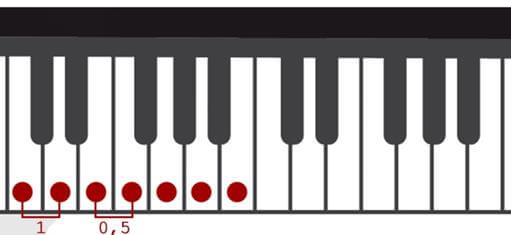
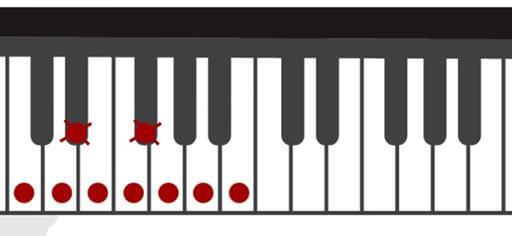
For example, the C major scale contains the notes C, D, E, F, G, A, B, arranged in that pattern. When writing a chord progression in C major, we use chords built from these notes. Introducing tones such as D♯ or G♭ will sound out of key.
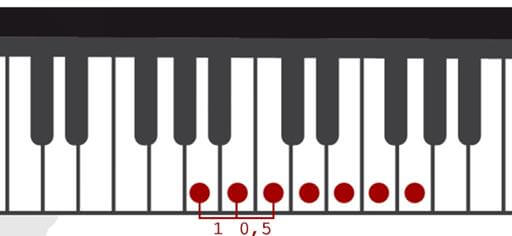
The A natural minor scale contains exactly the same notes (A, B, C, D, E, F, G), only starting from A instead of C. Keys like C major and A minor are called parallel (or relative) keys. One corresponds to a major sound, the other to a minor one. The difference in mood is established by the tonic — the home chord. In C major, the tonic is C major (C–E–G). In A minor, it is A minor (A–C–E).
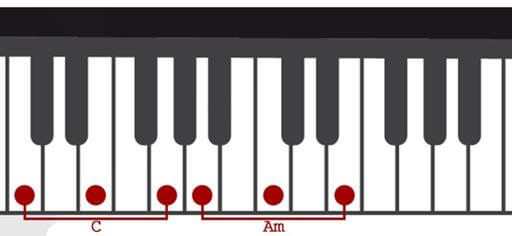
How to read and notate chord progressions?
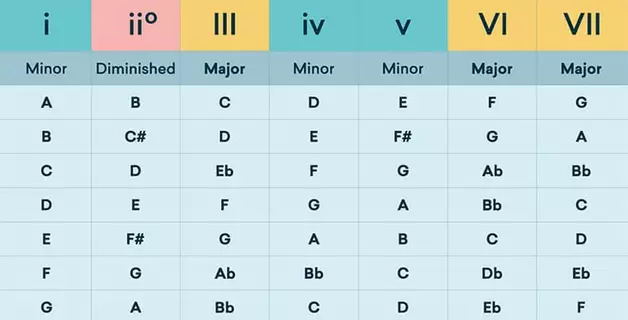
In C major or A minor, the seven diatonic triads are:
C major (C), D minor (Dm), E minor (Em), F major (F), G major (G), A minor (Am), and B diminished (Bdim).
The letter m means minor. Dim means diminished, a chord built from two stacked minor thirds.
A regular B minor chord would require the note F♯, which is not in the key of C major, so the diatonic seventh chord in this position is Bdim.
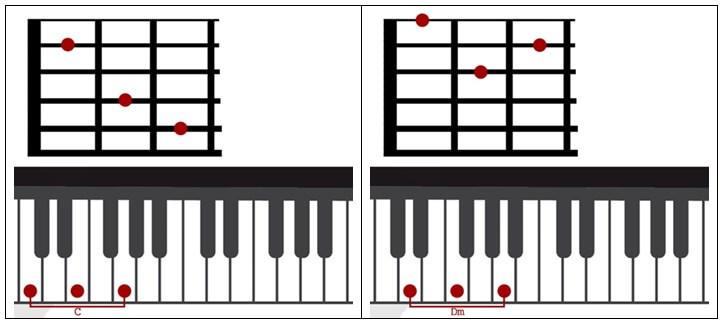
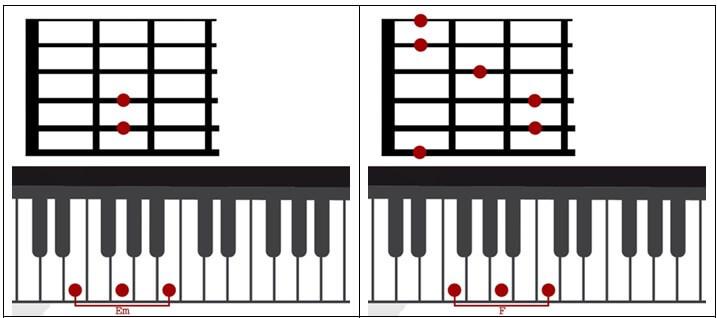
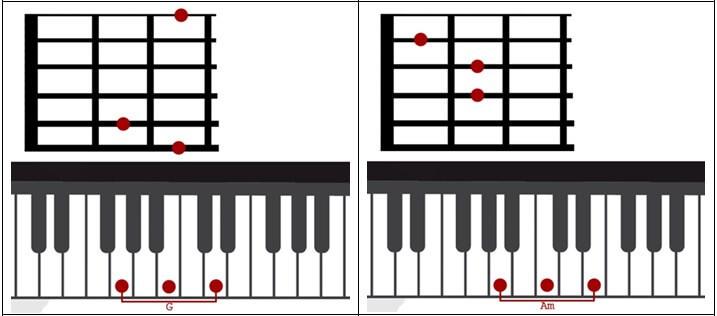
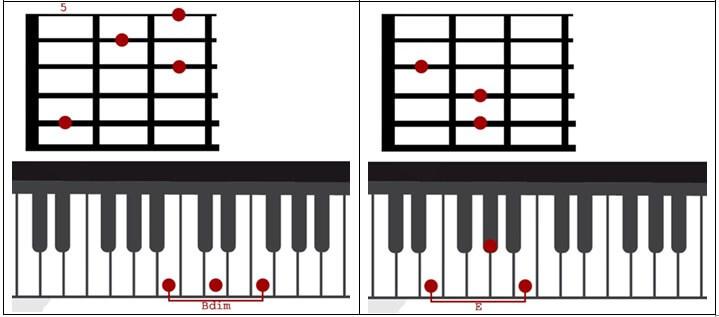
In many common chord progressions, E major (E) is used instead of E minor (Em). This comes from the harmonic minor scale, where the seventh degree of A minor is raised from G to G♯, making E major more strongly pull toward the tonic A minor. This substitution creates a clearer and more expressive resolution.
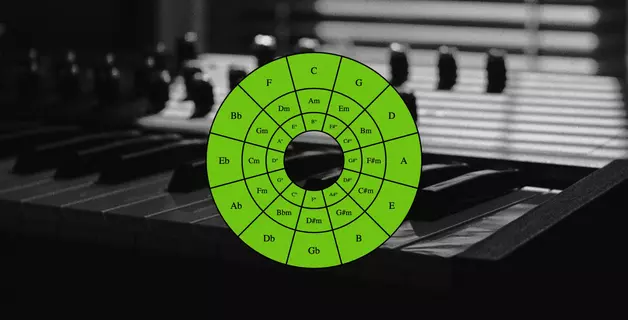
The most common chords used in simple progressions are Am, C, Dm, E, F and G. But if a vocalist finds this key uncomfortable, we simply choose another. For example, F♯ minor contains the chords: F♯m, A, Bm, C♯, D and E. The note names change, but these are still the same major and minor triads with the same functional roles.
To simplify thinking, musicians often replace letter names with scale degrees written as Roman numerals:
- I – tonic
- II – chord built on the second degree
- III – third degree
- IV – subdominant
- V – dominant
- VI – usually substitutes the subdominant
- VII – functions similarly to the dominant
In a minor key, the VII degree corresponds to the V in its parallel major. This allows smooth modulation between relative keys. For example, if we are playing a darker progression Am–F–Dm–E and want to transition to a brighter mood, we can use Am–F–Dm–G. After G, the major progression C–Am–F–G will sound natural and logically connected.
Here we have already analyzed the two most common and well-known chord progressions. But before moving on to other examples, let’s make a few remarks.
- By steps, chords can be denoted not only by Roman numerals, but also by Arabic ones: 1, 2, 3, 4, 5, 6, 7.
- In order to understand right away, a minor triad must be set or a major one, the first ones are indicated in small letters (for example, vi), the second – in large letters (for example, VI).
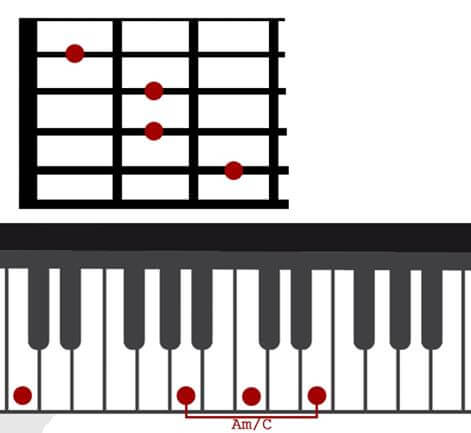
- There is a designation through a slash sometimes: for example, Am / C. This does not mean that you can put either Am or C. It means that we hold Am and the bass note C. On the guitar with the little finger, on the piano with any finger of the left hand.
Examples of the most common chord progressions
The foundation of many harmonic progressions comes from the tonic (I), dominant (V) and subdominant (IV). These can be expanded using other degrees (II, III, VI, VII), which still serve dominant or subdominant functions depending on context.
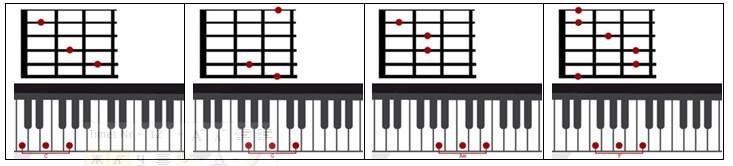
I–V–vi–IV
Found in countless pop, rock and punk songs. A major-key progression where the sixth degree adds a softer color.
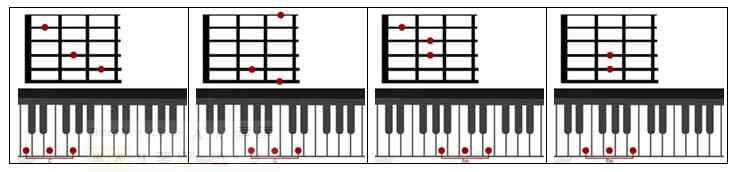
I–V–vi–iii
Associated with the Pachelbel Canon (“Canon in D”). One of the most recognizable classical patterns.
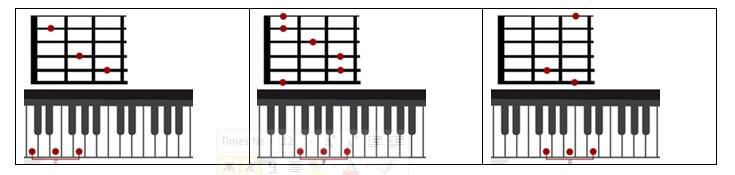
12-bar blues (I–I–I–I–IV–IV–I–I–V–IV–I–I)
The standard progression for blues forms. Despite the number of measures, it uses only I, IV and V.
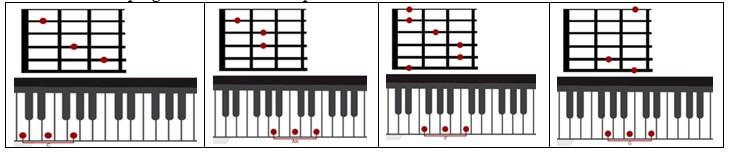
I–vi–IV–V (doo-wop progression)
A characteristic cheerful 1950s sound, still used today in retro-influenced music.
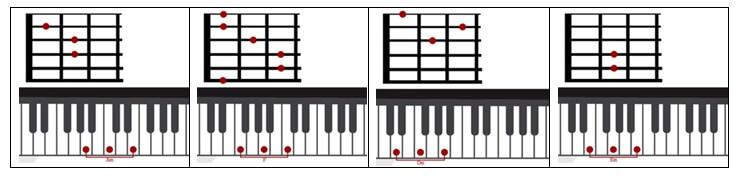
i–VI–iv–v
A common minor-key progression. It uses the same degrees as the doo-wop pattern, but the mood changes completely due to the minor tonic.
More examples worth exploring:
- I–IV–V
- I–V–vi–IV
- ii–V–I
- vi–IV–I–V
- I–IV–vi–V
Rules for writing chord progressions
One of the most common harmonization techniques is to support the melody with chords that contain its notes. Since melody notes belong to the key, all diatonic triads of that key are potentially suitable.
A safe approach is to emphasize the tonic at structurally important moments, such as the beginning or end of a phrase. If the tonic is absent for too long, the ear may begin to interpret another degree as the new tonal center. Relying on your ear is essential — music is subjective, and your sense of what sounds good is meaningful. If a progression works for you, use it.
If you don’t know where to start, listen to widely used progressions in well-known songs. Because you can now read chord symbols, analyze what is happening and adapt the ideas. The chord progressions described above are a good place to begin.
Having learned what chords and chord progressions are, how major and minor are constructed, how to read Roman numeral notation, and how common progressions function, you now have everything needed to start creating your own. Put this knowledge into practice — start experimenting right now.